

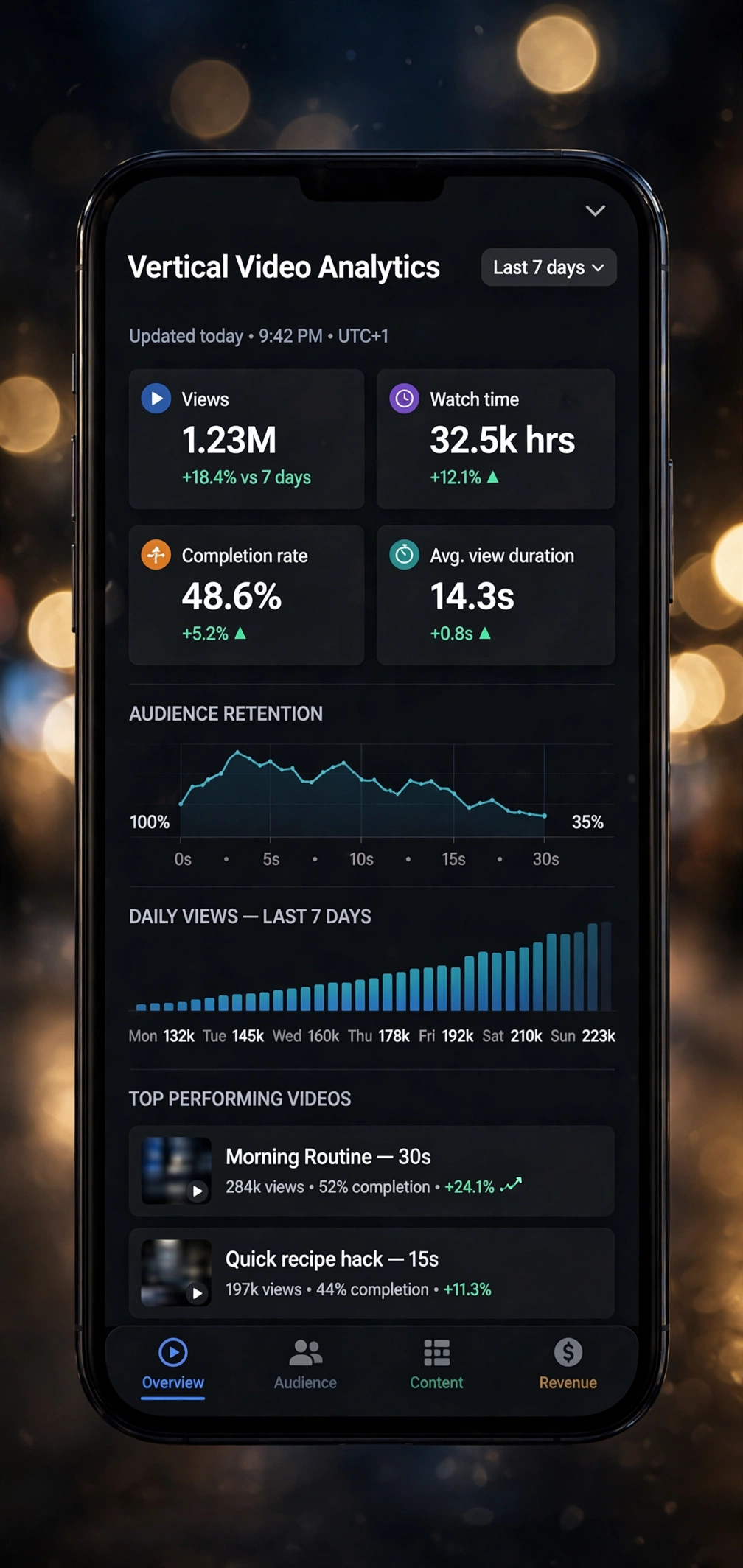
Average view duration on our catalogue is 14.3 seconds. That number is useless on its own, and for the first six months it was the only number we looked at.
The problem with an average is that short-form retention is not one curve. It is at least three, and they belong to different viewers watching for different reasons.
Three curves hiding inside one average
- The bounce. Roughly a third of views end inside two seconds. These are not viewers, they are a routing decision — the feed offered something and the thumb declined. Including them in an average drags every episode toward the mean.
- The sampler. Watches eight to twelve seconds, leaves before the turn. This is the group an episode can actually win or lose.
- The finisher. Watches past the turn and almost always completes. Once someone passes the turn, completion is close to a foregone conclusion.
Once we split them, the interesting question changed. It stopped being how long do people watch and became where is the turn, and how many samplers reach it.
Finding the turn
The turn is the frame where the episode stops being a setup and becomes a payoff. In our catalogue it lands between 6 and 9 seconds, and episodes that push it past 11 seconds lose roughly half their samplers.
retention(t) = bounce(t) + sampler(t) + finisher(t)

Writing that down changed how episodes get cut. Editors stopped trimming the end, which nobody was watching anyway, and started moving the turn earlier.

What Bangla changed
Two things that do not show up in English-language short-form research. First, code-switching between Bangla and English inside a sentence reads as natural to our audience and does not cost retention — we expected it to. Second, on-screen Bangla text needs noticeably longer on screen than the equivalent English, because the script is denser and our readers are reading it on a phone at arm's length.
The second one cost us about four months of unexplained drop-off before anyone thought to measure it.